Guides
August 14, 2026
What to Expect When Your Floor Gets Ground
How much dust, how much noise, whether you can stay in the house, and how long it takes. The practical answers before you book anyone.

How much dust, how much noise, whether you can stay in the house, and how long it takes. The practical answers before you book anyone.
The short answer: far less disruptive than most people expect. Dust extraction captures the dust at the source, so the rest of your house stays clean. Grinding is loud while it runs, but only for part of the job. Most home floors take a few days, and you can usually stay in the house. The mess people picture, grey dust settling on everything, is what happens without proper extraction, and it isn't how this work is done.
People rarely ask us this before they book. They ask afterwards, usually the day before we arrive, and usually with a slightly worried tone.
So here it is up front. This is what actually happens when a concrete floor gets ground, and what it's like to be in the building while it does.
This is what everyone is really asking, so let's deal with it properly.
Grinding concrete produces a lot of fine dust. There's no version of this work that doesn't. The difference is what happens to that dust, and that comes down to the equipment.
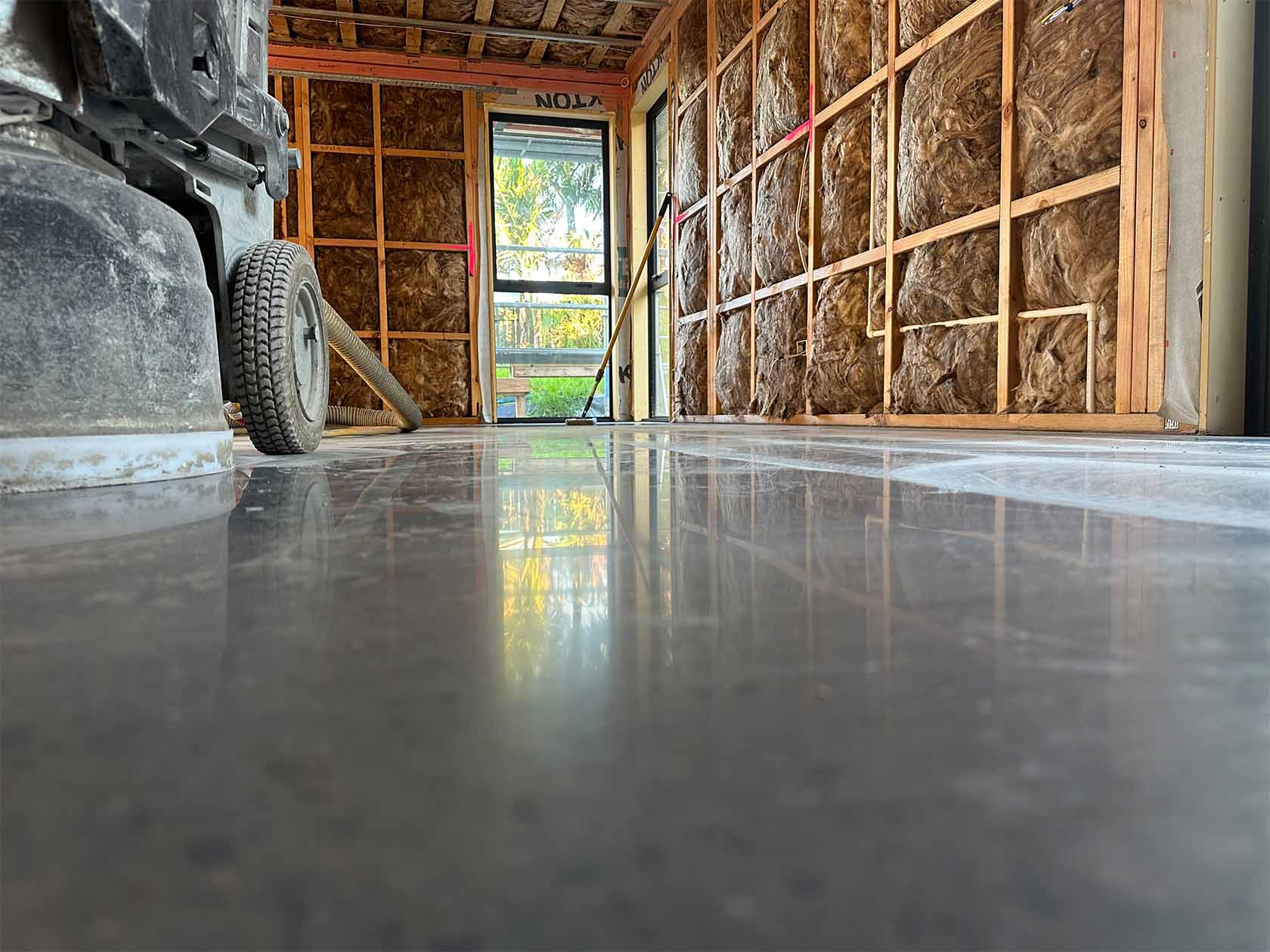
Our grinders run with industrial dust extraction connected directly to the machine. The dust is pulled off the floor at the point it's created, before it has a chance to go anywhere, and captured in the vacuum unit. What you see during the job is a machine and a hose, not a room filling with grey fog.
On top of that, we seal off the work area from the rest of the building. Doorways get covered, and anything that needs protecting gets protected before we start.
The honest caveat: no system captures every particle. You'll find some fine dust on surfaces near the work area, and it wipes off. What you won't get is dust through the whole house, in your wardrobes, on your furniture two rooms away. That happens when someone grinds without extraction, and it's the horror story people have heard about from a mate.
If anyone quotes you for floor grinding and doesn't mention dust extraction, ask about it directly.
Loud. There's no getting around that.
A concrete grinder and an industrial vacuum running together are genuinely noisy, roughly comparable to a floor sander or a concrete saw. You can hold a conversation in the next room, but not comfortably in the same one.
Two things make it manageable. First, it isn't constant across the whole job. Preparation, repairs, sealing and finishing stages are much quieter, and the loud part is a portion of the total time rather than all of it. Second, we'll tell you in advance which days are the noisy ones, so you can plan around them.
Plenty of clients simply go out on the grinding days. If you work from home, or you've got a baby sleeping, or a dog that won't cope, tell us at the quote stage and we'll work the schedule around it where we can.
If you share a wall with neighbours, it's worth giving them a heads up. Most people are fine about it if they know it's coming and know when it ends.
Usually, yes.
Most residential jobs are done room by room or area by area, with the work zone sealed off. You keep using the rest of the house, we work in ours, and the two don't overlap much beyond the noise.
What changes that is scale and layout. An open-plan living area that runs through the middle of the house is harder to work around than a garage or a single room. If the kitchen is in the work zone, that's a real disruption rather than a minor one. And if the whole ground floor is being done at once, staying is possible but not comfortable.
Jay will tell you honestly at the assessment which category your job falls into. It's a much better conversation to have before the work starts than on day two.
Not much, but the things we do need make a real difference to how smoothly it goes.
Clear floors. Furniture, boxes, appliances and anything else on the slab needs to be out of the work area. If moving heavy items is a problem, tell us at the quote stage and we can usually arrange it, but it's cheaper if you handle it.
Access to power and water. Standard household supply is fine for most residential work. Larger commercial jobs sometimes need three phase, and we'll confirm that well in advance.
Somewhere to park. The gear is heavy and it comes off a vehicle. Reasonable access to the work area saves time, and time is money on any job.
A conversation about anything sensitive. Antique furniture in the next room, a home studio, a fish tank, a family member who works nights. Tell us. We can plan around most things if we know about them.
Most home floors take a few days. The variables are size, what's on the floor now, what condition the slab is in, and which finish you've chosen.
A rough sense of the stages:
Preparation and removal. If there's carpet glue, tile mortar, old coatings or paint to come off, this happens first and it can take longer than the finishing does. A slab that's already bare is much quicker to start on. This is floor preparation, and it's usually the least predictable part of any job.
Repairs. Cracks, holes and damaged sections get dealt with before any finish goes down. Repairs need curing time, which sometimes means a gap in the schedule rather than continuous work.
Grinding. The noisy part, and the part where your floor changes completely. This is where the stone in the slab comes through.
Finishing. Polishing stages, or sealing, depending on which service you're having. Polishing takes longer than sealing because there are more stages to work through.
Curing and handover. Sealers and protectors need time before the floor takes foot traffic, and longer again before vehicles or furniture. We'll give you exact timings, and they're worth following. Walking on a floor too early is one of the few ways to damage a brand new finish.
Your quote will have a schedule in it. If a job is running to a hard deadline, like a shop reopening or a settlement date, say so at the quote stage and we'll tell you honestly whether it's achievable.
Worth preparing for, because it surprises people.
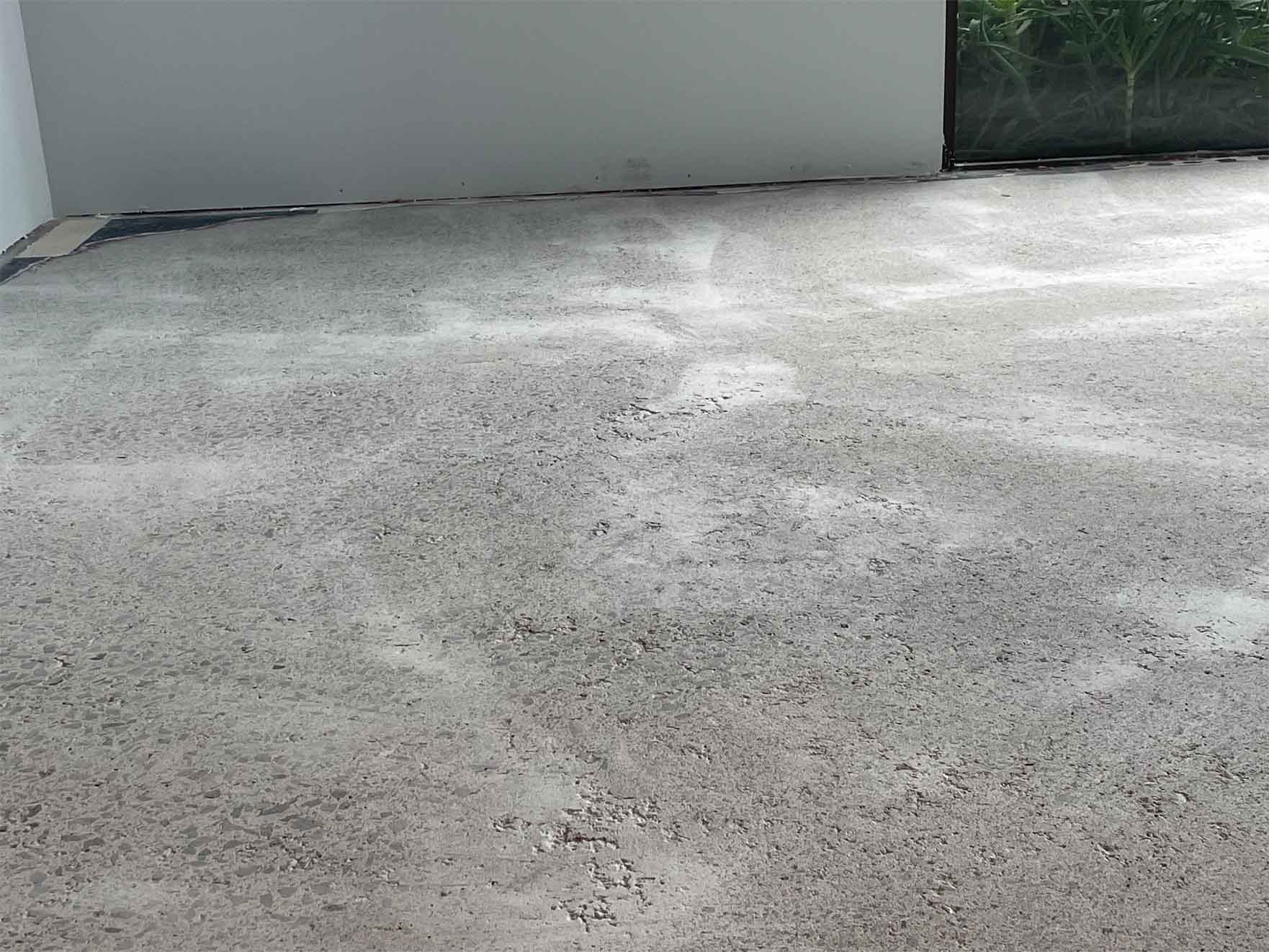
A floor mid-grind looks rough. Uneven, patchy, streaked, with the stone showing in some areas and not others. It's normal, and it's what a floor looks like between stages, not what it's going to look like finished.
Every stage evens it out further. The floor you see after the first pass and the floor you see at handover are barely comparable. If something looks wrong to you partway through, ask, and we'll explain what stage it's at. But don't panic on day two.
Sometimes grinding reveals things nobody knew about. Old repairs, soft patches, buried fixings, previous coatings under the coating we knew about, or damage that was hidden under whatever was on the floor.
Our rule is simple. We stop and talk to you before anything changes. No work beyond the quote happens without you agreeing to it in writing, and you'll get the options and the cost before you decide.
It doesn't happen on most jobs. But concrete is an existing material with a history, and anyone who tells you there's zero chance of a surprise hasn't ground many floors.
We walk the finished floor with you before we call it done. Anything that isn't right gets sorted then, not later.
You'll get simple care instructions: what to clean it with, what to avoid, and when the protection needs topping up. It's genuinely straightforward, and following it is what keeps a warranty valid. More on looking after a finished floor here.
Then the floor is yours, and if we've done it properly you won't think about it again for a very long time.
Thinking about it but not sure what it involves?
Jay will come and look at your floor, walk you through what your job would actually involve, and give you a fixed price. No obligation and no call centre.
Jay will come and look at it, tell you honestly which service it needs, and give you a fixed price. No obligation and no call centre.